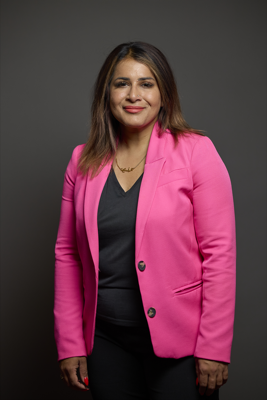
Naushabah Khan's most visible recent actions have been local and deliberate. She lobbied successfully to bring a banking hub to Rainham after NatWest closed, and has spent much of the past year pressing Medway Council to clamp down on the proliferation of houses in multiple occupation — writing formally to council leadership, proposing a licensing scheme, and speaking publicly about the impact on community character. That campaign, drawing on her background as a former councillor, has generated sustained local coverage. On assisted dying, she voted against her party at both Second Reading and Third Reading of the Terminally Ill Adults (End of Life) Bill — her only two rebel votes — signalling a consistent personal position on that question rather than a one-off dissent.
At Westminster, Khan participates in 79% of votes, broadly in line with the Commons average for a 2024 intake MP, and votes with Labour in 99.6% of divisions — making assisted dying a narrow but firm exception. Her 66 contributions across 45 debates skew heavily toward local government, economy and jobs, health, and housing, reflecting her constituency casework priorities. Stance data shows she is strongly aligned with workers' rights measures and progressive taxation, and sits notably below her party average on supporting opposition-day motions, Lords scrutiny, and civil liberties votes.
Khan holds no committee seat, which limits her formal legislative influence at this stage. The deviations from party average worth noting are her stronger-than-typical support for welfare reform and NHS funding, and her lower scores on criminal justice reform and public health measures. Local news coverage over the past year has been consistently positive in tone, centred almost entirely on housing and constituency services. Parliamentary speech data extends to July 2026; news sentiment data for the most recent 90-day window is insufficient to assess.